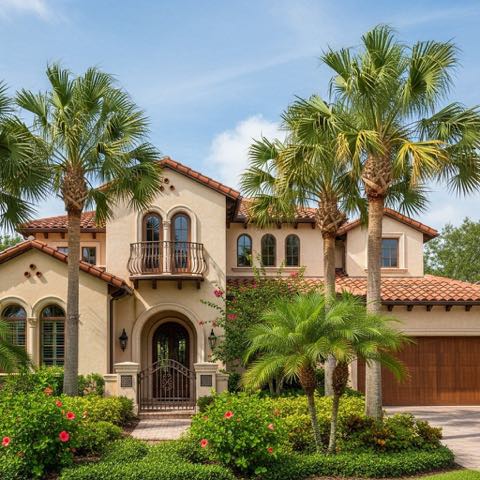
EIFS Repair in St. Augustine, FL
Synthetic stucco repaired as the system it actually is, starting with where the water is getting in.
About This Service
EIFS is not stucco with a different name. It is a synthetic finish over foam board, and it fails in ways traditional stucco does not. Older barrier EIFS has no way to drain, so any water that gets past the surface stays against the sheathing behind it. In Northeast Florida that water arrives through the same few places every time: window and door perimeters, roof-to-wall junctions with no kickout flashing, deck ledgers, and anywhere a pipe or light penetrates the wall. The damage is usually well established before the outside shows anything. We probe before we open anything up, find the actual entry point rather than the stain, and repair the lamina and mesh so the system is continuous again.
What's Included
- Moisture probing and mapping
- Barrier and drainage EIFS repair
- Window and door perimeter detailing
- Kickout and step flashing correction
- Sheathing and framing replacement where wet
- Foam board and mesh replacement
- Base coat and lamina rebuild
- Finish texture and color matching
Our Process
Probe First
Moisture readings taken through the finish tell us where water sits. On EIFS this matters more than anywhere else, because the surface hides everything behind it.
Find the Entry
We trace the water back to the detail that let it in. Repairing the wet area without fixing the entry point buys a year at most.
Open and Dry
The affected area is opened, wet sheathing and framing are replaced, and the assembly is dried before anything is rebuilt.
Correct the Detail
Flashing, sealant joints, and terminations are rebuilt so the system drains the way it was designed to.
Rebuild the System
Foam, base coat, and mesh are replaced with matching materials and lapped so the lamina is continuous rather than butted.
Finish and Blend
The finish coat is matched in texture and color and feathered into the surrounding wall.
Benefits
- The entry point fixed, not just the stain
- Hidden moisture found before framing goes
- Barrier and drainage systems both handled
- Repairs lapped into the existing lamina
- One contractor for flashing, framing, and finish
Frequently Asked Questions
How do I know if I have EIFS or traditional stucco?
EIFS sounds hollow and gives slightly under a knuckle because there is foam behind it. Traditional stucco is hard and solid over lath. If you are not sure, a probe at an inconspicuous spot settles it in a minute.
What are the early signs of an EIFS problem?
Staining below windows, a soft or spongy spot, sealant that has pulled away at a perimeter, and interior signs like swollen baseboards or a musty smell in a closet on an exterior wall. Woodpecker holes are also a genuine tell, because they go after insects that are already in wet sheathing.
Is barrier EIFS worse than drainage EIFS?
It is less forgiving. Barrier systems rely entirely on the surface staying sealed, so any breach puts water against the sheathing with no way out. Drainage systems give that water a path. Both fail at the same details, but barrier systems do more damage before anyone notices.
Can EIFS be patched like stucco?
No. A traditional stucco patch on EIFS will not bond correctly and will not restore the mesh, which is what gives the lamina its strength. The base coat and mesh have to be lapped into the existing system.
Do you replace the sheathing behind wet EIFS?
Where the water reached it, yes. Rebuilding a wall over wet or rotted sheathing is the single most common way an EIFS repair fails a second time.
Will the repair be visible?
The finish is matched in texture and color and feathered into the surrounding wall. EIFS finishes are manufactured products, which usually makes matching more predictable than hand-floated stucco.
Should I replace EIFS entirely?
Sometimes, and it is an honest conversation rather than a default. If the failures are isolated to a few details, repair is the right call. If water has been getting in across several elevations for years, replacement can cost less than chasing it.
Get a Free Estimate
Ready to get started? Call us or request a free inspection today.
(904) 526-2075Request InspectionLicensed General Contractor
License #CGC1534920
EIFS Repair Service Areas
- EIFS Repair in St. Augustine
- EIFS Repair in St. Augustine Beach
- EIFS Repair in Ponte Vedra
- EIFS Repair in Nocatee
- EIFS Repair in World Golf Village
- EIFS Repair in Julington Creek
- EIFS Repair in Fruit Cove
- EIFS Repair in Hastings
- EIFS Repair in Jacksonville
- EIFS Repair in Jacksonville Beach
- EIFS Repair in Neptune Beach
- EIFS Repair in Atlantic Beach
- EIFS Repair in Mandarin
- EIFS Repair in Orange Park
- EIFS Repair in Fleming Island
- EIFS Repair in Green Cove Springs
- EIFS Repair in Fernandina Beach
- EIFS Repair in Yulee
- EIFS Repair in Palm Coast
- EIFS Repair in Flagler Beach
- EIFS Repair in Ormond Beach