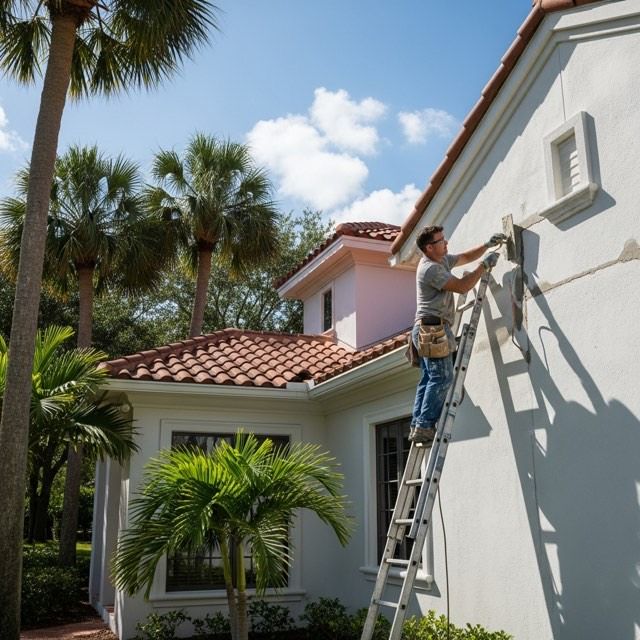
Full Stucco Refinishing in St. Augustine, FL
For walls where a dozen matched patches would cost more and look worse than starting the finish again.
About This Service
There is a point where patching stops being the economical answer. When an elevation carries repairs from several different years, when the texture no longer matches itself across a wall, or when crazing and weathering have made the finish read as patchy from the street, refinishing the whole surface costs less than chasing it and produces a wall that looks like one wall. The important part is what happens before the finish goes on. Refinishing over a wall that is holding water is the most expensive mistake available here, because it hides the problem behind a new surface and buys perhaps two years. We resolve moisture and substrate first, then refinish.
What's Included
- Whole-elevation surface assessment
- Moisture testing before any finish work
- Repair of cracks, spalls, and failed patches
- Pressure washing and surface preparation
- Bonding agent and base coat where needed
- Fog coat, finish coat, or elastomeric build
- Uniform texture across the full elevation
- Color selection and consistent application
Our Process
Assess the Whole Wall
We look at the elevation as one surface rather than a set of defects, because that is how anyone standing in the street sees it.
Test for Moisture
Refinishing traps whatever is already in the wall. Readings come first, and if the wall is wet the repair comes before the finish.
Repair the Substrate
Cracks, spalled areas, and old failed patches are cut back and rebuilt so the new finish goes over sound, consistent material.
Prepare the Surface
Washing, profiling, and a bonding agent where the existing finish is chalked or sealed, so the new coat adheres instead of sitting on top.
Apply the Finish
Fog coat, a new finish coat, or an elastomeric build depending on the wall's condition and how much movement it has to accommodate.
Work Wall to Wall
Each elevation is finished in one pass, wet edge maintained, so there is no lap line halfway across the front of the house.
Benefits
- One consistent surface rather than visible history
- Moisture resolved before it is covered up
- Old failed patches removed, not painted over
- Color and texture uniform across each elevation
- A finish specified to the wall's actual movement
Frequently Asked Questions
When is refinishing better than patching?
When the repairs needed across an elevation are numerous enough that matching them all costs more than refinishing, or when previous patches have already made the wall read as uneven. At that point a matched patch is still a patch.
What is a fog coat?
A thin cementitious coat that restores color and evens out a weathered finish without changing the texture. It works well on walls that are sound but faded, and it is the lightest of the options.
Should I use elastomeric coating?
It depends on the wall. Elastomeric bridges hairline movement well, which suits walls that crack seasonally. It also slows drying, so it is the wrong choice on a wall that is holding moisture and has not been fixed first.
Can you refinish over existing paint?
Often, with preparation. Chalked, peeling, or heavily sealed paint has to come off or be profiled first, because a new finish is only as good as what it is bonded to.
Will refinishing fix my cracks permanently?
It addresses the cracks present now and, with the right system, accommodates normal movement. It does not fix a structural cause. If a crack is moving because the house is, that gets identified before we finish over it.
How long does refinishing take?
It depends on the size of the house, the condition of the substrate, and the weather, since coats need to cure and Northeast Florida humidity affects that. The repair stage varies far more than the finish stage.
Do you refinish one elevation or the whole house?
Either, though a single elevation refinished against three weathered ones can look newer than the rest. We will tell you honestly how it will read from the street before you decide.
Get a Free Estimate
Ready to get started? Call us or request a free inspection today.
(904) 526-2075Request InspectionLicensed General Contractor
License #CGC1534920
Full Stucco Refinishing Service Areas
- Full Stucco Refinishing in St. Augustine
- Full Stucco Refinishing in St. Augustine Beach
- Full Stucco Refinishing in Ponte Vedra
- Full Stucco Refinishing in Nocatee
- Full Stucco Refinishing in World Golf Village
- Full Stucco Refinishing in Julington Creek
- Full Stucco Refinishing in Fruit Cove
- Full Stucco Refinishing in Hastings
- Full Stucco Refinishing in Jacksonville
- Full Stucco Refinishing in Jacksonville Beach
- Full Stucco Refinishing in Neptune Beach
- Full Stucco Refinishing in Atlantic Beach
- Full Stucco Refinishing in Mandarin
- Full Stucco Refinishing in Orange Park
- Full Stucco Refinishing in Fleming Island
- Full Stucco Refinishing in Green Cove Springs
- Full Stucco Refinishing in Fernandina Beach
- Full Stucco Refinishing in Yulee
- Full Stucco Refinishing in Palm Coast
- Full Stucco Refinishing in Flagler Beach
- Full Stucco Refinishing in Ormond Beach