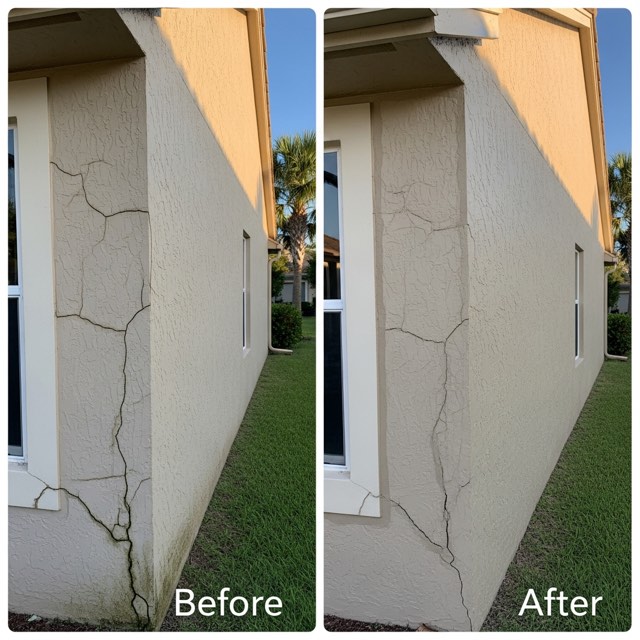
Hurricane Stucco Damage Repair in St. Augustine, FL
Storm damage stucco repair across St. Augustine and Northeast Florida, from impact damage to the water that got in behind the wall.
About This Service
After a storm, the stucco damage you can see is rarely the whole story. Wind-driven rain does not need a hole to get in. It finds the hairline cracks at window corners, the failed sealant around penetrations, and the gaps where trim meets wall, and it pushes water sideways into the wall assembly at pressures a normal rain never reaches. Weeks later that shows up as a soft spot, a stain on an interior wall, or paint lifting off in sheets. We inspect storm-hit stucco for both kinds of damage, take moisture readings behind the surface rather than guessing from the outside, and repair it so the wall drains and dries the way it was built to.
What's Included
- Impact damage from wind-borne debris
- Wind-driven rain intrusion behind the wall
- Moisture testing before any repair starts
- Window and door perimeter resealing
- Cracked and delaminated stucco removal
- Lath and substrate repair where the wall is wet
- Texture and color matching to the existing finish
- Photo documentation for your insurance claim
Our Process
Storm Assessment
We walk the whole exterior, not only the elevation that took the visible hit, and note every crack, impact point, and failed seal.
Moisture Testing
Probe and meter readings tell us where water actually sits behind the stucco. Repairing over a wet wall traps the damage inside it.
Claim Documentation
Photographs, readings, and a written scope of the damage, in the form an adjuster expects to receive.
Dry-In
Open areas get covered and the wall is allowed to dry to a normal moisture reading before anything is closed up.
Structural Repair
Damaged lath, sheathing, and framing are replaced where the water reached them.
Finish and Match
New stucco is built up in coats, textured to match the surrounding wall, and color matched so the repair does not read as a patch.
Benefits
- Hidden water damage found before it spreads
- Repairs an adjuster can follow and verify
- The wall dries before it is closed up
- Repairs that blend with the existing finish
- One contractor for stucco, lath, and finish
Frequently Asked Questions
How soon after a storm should stucco be inspected?
As soon as it is safe to walk the property. Wind-driven rain that got behind the wall keeps causing damage while it sits there, and the earlier a wall is opened and dried, the less of it has to be replaced.
My stucco looks fine after the storm. Do I still need an inspection?
Often yes. Wind-driven rain enters through cracks too small to notice from the ground and through sealant joints that look intact. The first visible sign is usually an interior stain or soft drywall weeks later, by which point the repair is larger.
Will my insurance cover hurricane stucco damage?
That depends on your policy and how the damage is documented. What we control is the documentation: photographs, moisture readings, and a written scope that shows what failed and why, in the form adjusters expect.
Can you match the existing stucco texture and color?
Yes. Texture matching is its own step, and we build the finish up in coats and match it to the surrounding wall so the repair is not obvious. Older walls that have weathered take more work to match than recent ones.
What is the difference between emergency dry-in and permanent repair?
Dry-in stops more water getting in and lets the wall dry out. Permanent repair happens after the moisture readings come back to normal. Closing a wet wall up permanently is how a storm repair turns into a rot problem.
Do you repair EIFS after storm damage?
Yes. EIFS behaves differently from traditional stucco after a storm because it holds water against the substrate rather than letting it drain, so it needs a different inspection and a different repair. We handle both.
How long does hurricane stucco repair take?
It depends on how wet the wall is. The drying step sets the schedule more than the stucco work does, and rushing it is the one shortcut that guarantees the repair fails.
Do you work with my adjuster?
We provide the documentation and the scope, and we are happy to walk the damage with an adjuster on site so everyone is looking at the same wall.
What areas do you cover for storm damage?
St. Augustine, Jacksonville, Ponte Vedra, Palm Coast, Nocatee, and the surrounding Northeast Florida coast.
Get a Free Estimate
Ready to get started? Call us or request a free inspection today.
(904) 526-2075Request InspectionLicensed General Contractor
License #CGC1534920
Hurricane Damage Repair Service Areas
- Hurricane Damage Repair in St. Augustine
- Hurricane Damage Repair in St. Augustine Beach
- Hurricane Damage Repair in Ponte Vedra
- Hurricane Damage Repair in Nocatee
- Hurricane Damage Repair in World Golf Village
- Hurricane Damage Repair in Julington Creek
- Hurricane Damage Repair in Fruit Cove
- Hurricane Damage Repair in Hastings
- Hurricane Damage Repair in Jacksonville
- Hurricane Damage Repair in Jacksonville Beach
- Hurricane Damage Repair in Neptune Beach
- Hurricane Damage Repair in Atlantic Beach
- Hurricane Damage Repair in Mandarin
- Hurricane Damage Repair in Orange Park
- Hurricane Damage Repair in Fleming Island
- Hurricane Damage Repair in Green Cove Springs
- Hurricane Damage Repair in Fernandina Beach
- Hurricane Damage Repair in Yulee
- Hurricane Damage Repair in Palm Coast
- Hurricane Damage Repair in Flagler Beach
- Hurricane Damage Repair in Ormond Beach